
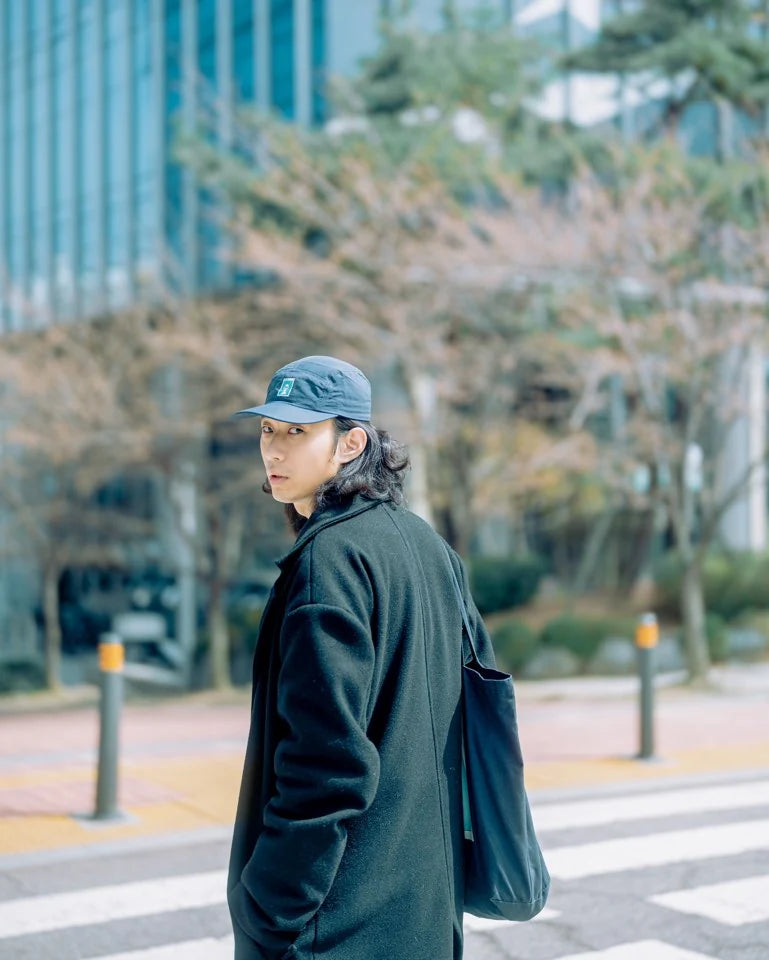
At WorkWith:Suin
Suin joined HITCH as a designer who understood coffee. She shaped its identity and merchandise, then met the people buying them at the counter and at fairs. Today, she works with Tinge of Soul on brand planning and design projects.
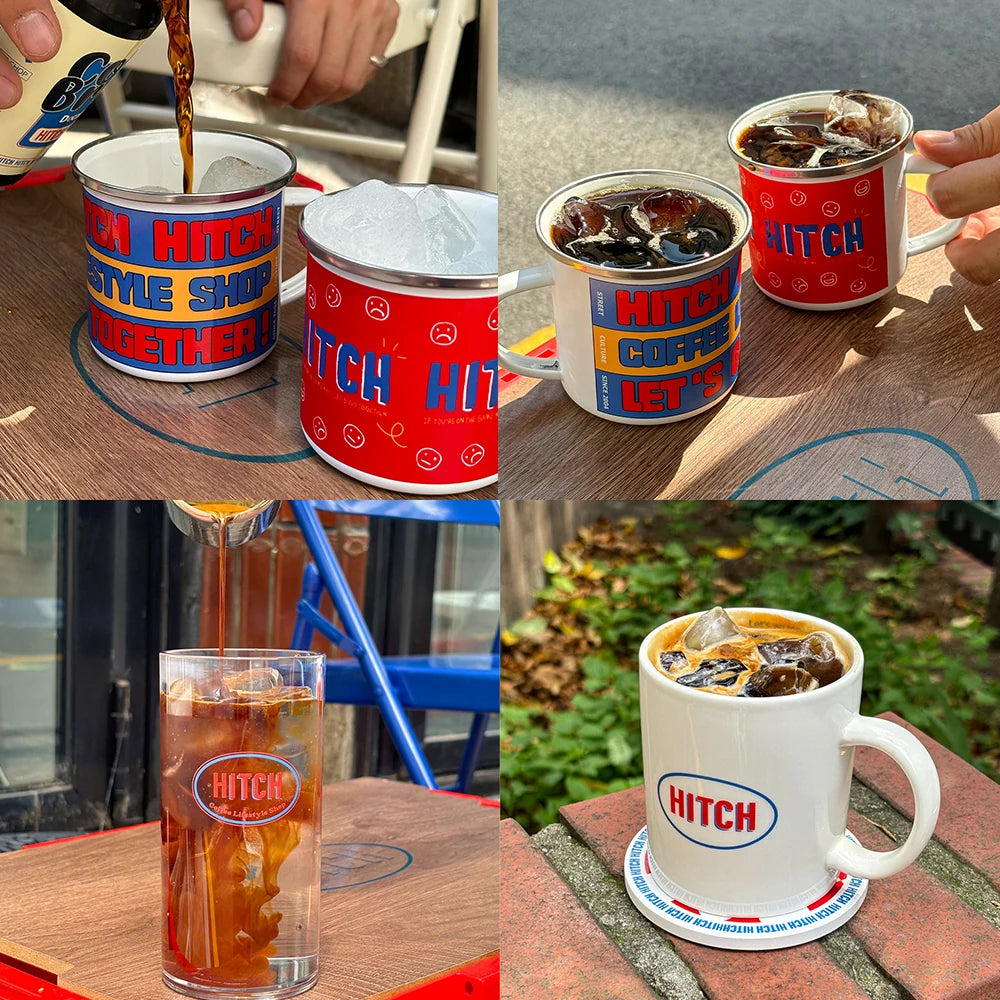
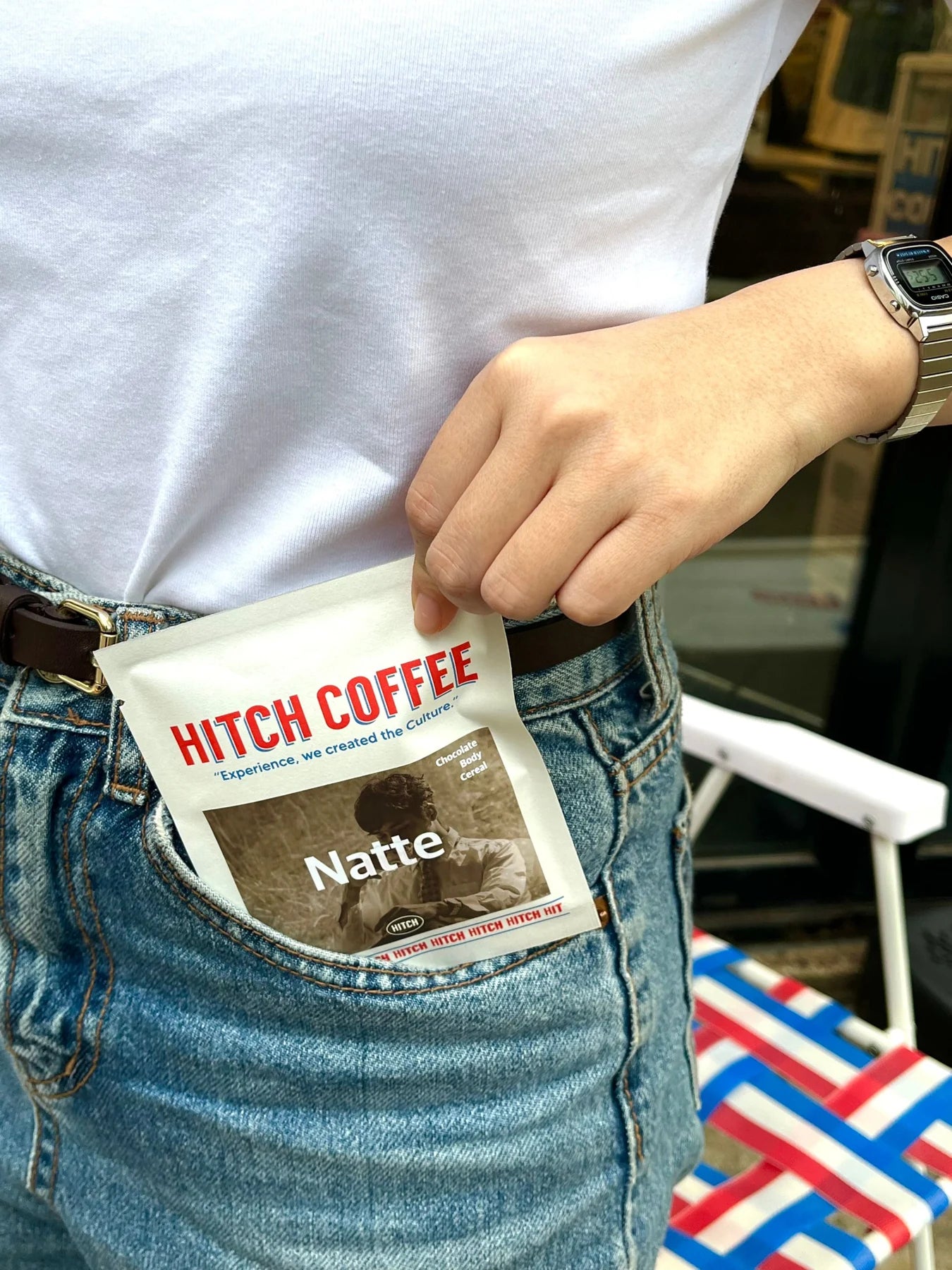
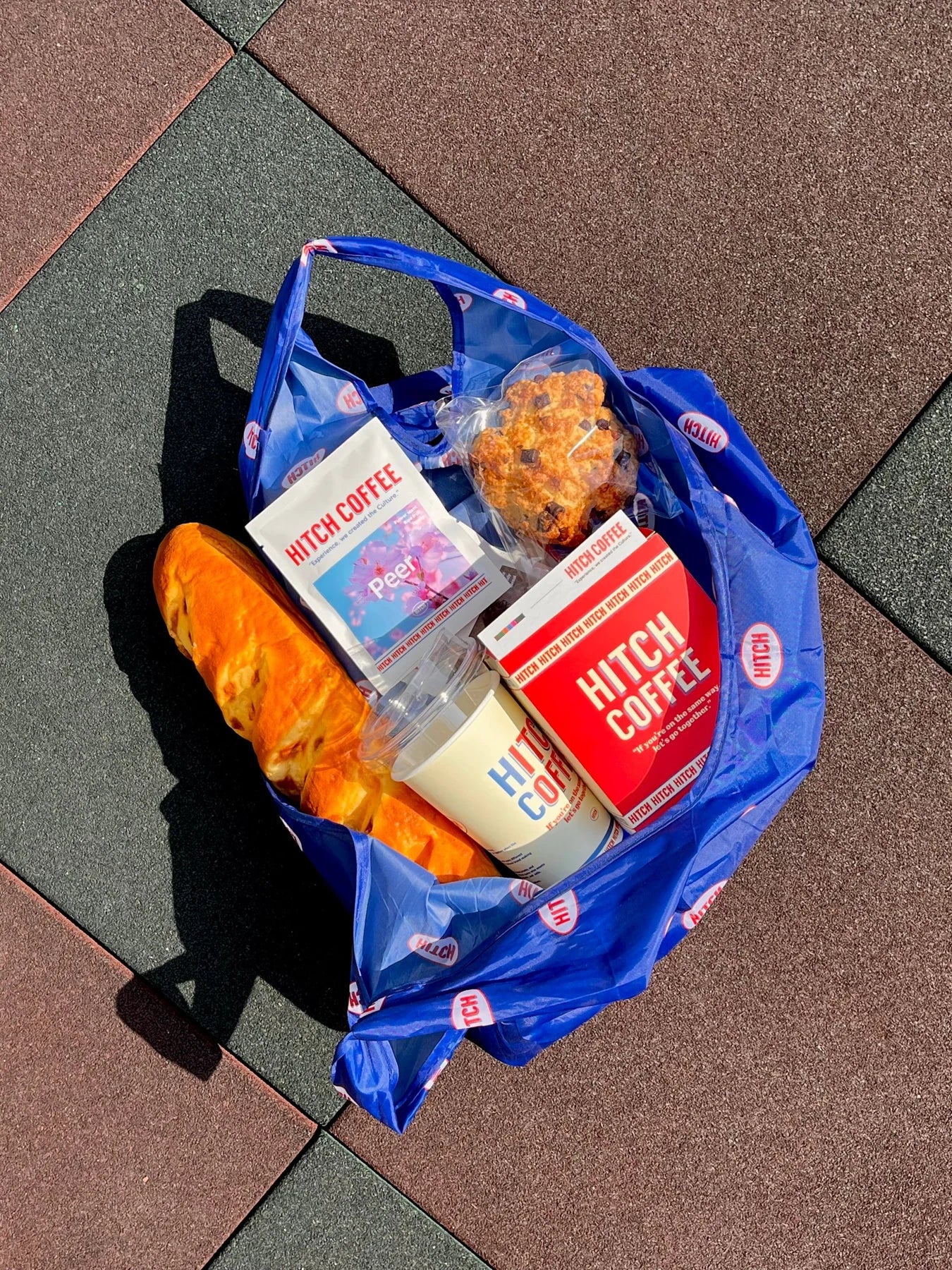
At HITCH, a small café in Munjeong-dong, Seoul, red lettering, a blue carpet and checked coasters greet you at the door. From cups and tape to coffee bags and shopping bags, the same identity runs through every detail. The designer behind it also made coffee at the counter and met customers at fairs. Her name is Chae Suin.
HITCH had been looking for a designer for four months. Freelancers and designers unfamiliar with coffee had struggled to connect their work with the realities of the café. Then, by chance, they met Suin, who was moving between coffee work and a design company. From her early to mid-thirties, she built the neighbourhood roastery’s identity and merchandise, introduced it through coffee fairs and social media, and welcomed customers in the shop. On her last day, a regular customer wrote a blog post for her.
She now works with Tinge of Soul on brand planning and the design of OEM products. What does a designer do? We asked her.
What is a designer’s role?
On your last day at HITCH, a regular customer wrote a blog post called ‘Last Dance’.
I worked at HITCH from my early to mid-thirties. I consider those important years in my life, and they were the years when I enjoyed my work most and felt proudest as a designer. I was very grateful for that ‘Last Dance’ post.
It wasn’t the mechanical work of producing whatever layout a company requested and handing it over. I experienced the whole process: selling products I had designed, seeing the results and watching people take an interest. We started very small and grew into something quite substantial by my standards. Design played a clear part in that. I remember that last day so fondly that I wanted to leave a record of the time we spent together.
What does being a designer mean to you?
I used to think a designer was simply someone who designs. As AI developed so quickly, making visuals alone became less appealing to me. Now I think a designer is someone who builds a brand. You go beyond producing a proposal and stay with the work through to the final sale. That is my definition of a designer.
Someone who makes an idea visible, turns something intangible like a philosophy into an object you can touch, and helps it reach a sale?
Exactly. If a designer stops at the visual result, I think that is closer to being an artist. To me, becoming a designer means seeing the process through until an actual sale happens.
Was there a particular moment that changed your thinking?
My time at HITCH was the biggest turning point. I saw my designs sell, and I experienced people’s responses turning into revenue. That was exhilarating. Having seen sales both before and after the rebranding changed my perspective as a designer completely.
If you only make the design, that is closer to being an artist. To me, a designer sees the work through to the final sale.Suin
From a neighbourhood roastery to HITCH
What was HITCH like when you first joined?
It was a small neighbourhood roastery, a café with a handful of wholesale coffee accounts. The owner wanted to grow the business, establish steady B2B and B2C sales and build a proper brand. At first that was quite an open-ended ambition, but we encouraged each other, attended fairs and built up the design piece by piece. The business grew naturally along the way.
How did you meet the owner?
I only knew of the owner through other people. A close friend worked there and told me HITCH was looking for a designer who understood coffee. Outsourcing and working with designers unfamiliar with coffee kept leading to misunderstandings about practical things, such as the character of the beans or how people moved around the shop. They had been searching for four months. I happened to be working between coffee and a design company, so the timing was right.
How did the name HITCH and the slogan ‘If you’re on the same way, let’s go together.’ come about?
The most important task was making the owner’s ideas visible. At the heart of the coffee he wanted to serve was accessibility: coffee anyone could enjoy comfortably, without finding it difficult.
The owner chose HITCH from hitchhiking, and we developed ‘Let’s go together’ together. We agreed to build a coffee brand that felt as easy to approach as setting out on a hitchhiking trip, using words that welcomed everyone.
Why did you choose such vivid red and blue as the main colours?
The owner wanted a slightly kitsch identity. Red and blue were the colours we associated with that mood, and we decided to make them highly saturated so they would catch the eye at once. We were still a small brand. When a small business goes to a large fair, it needs that kind of clarity to attract people’s attention.
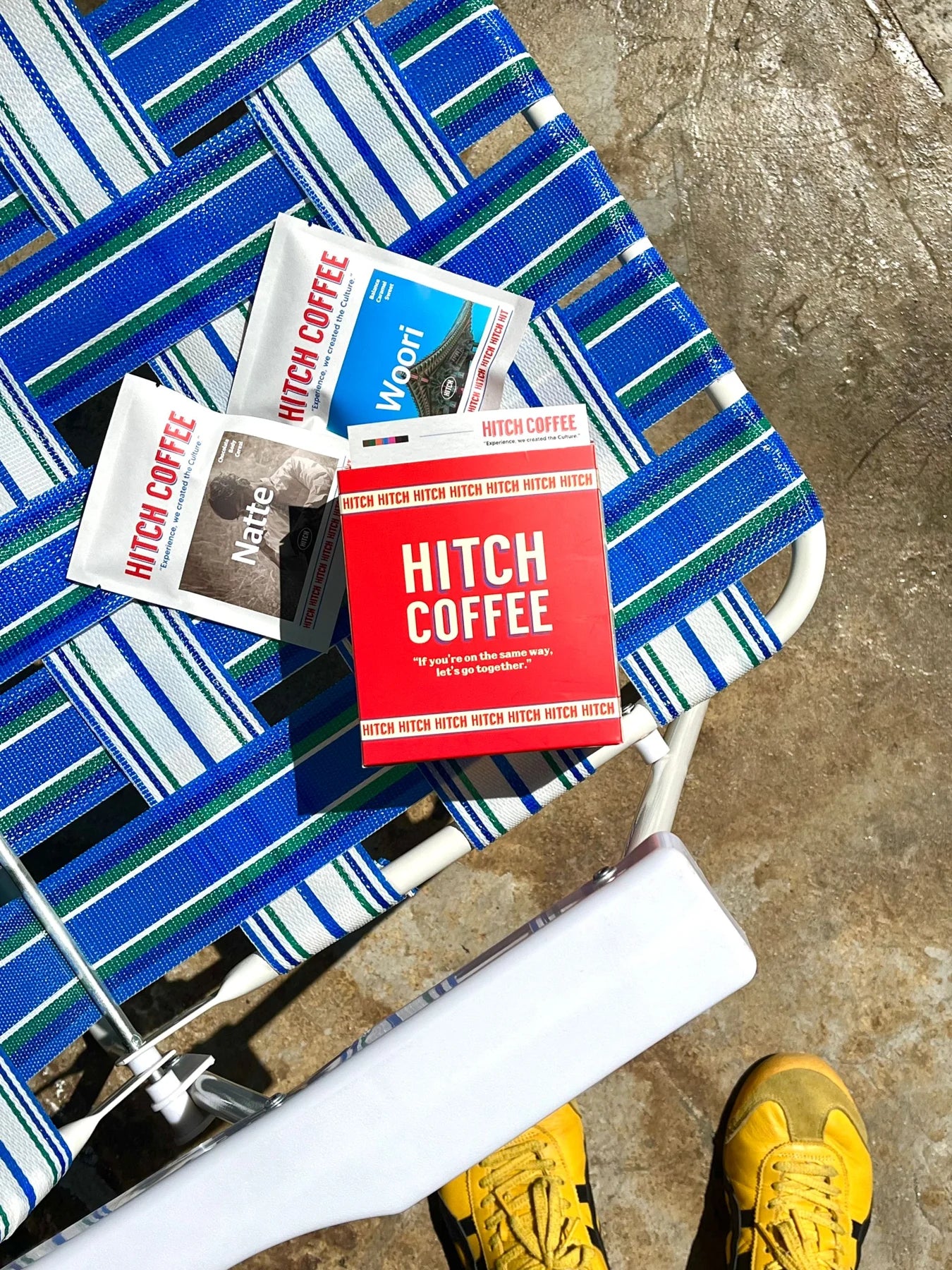
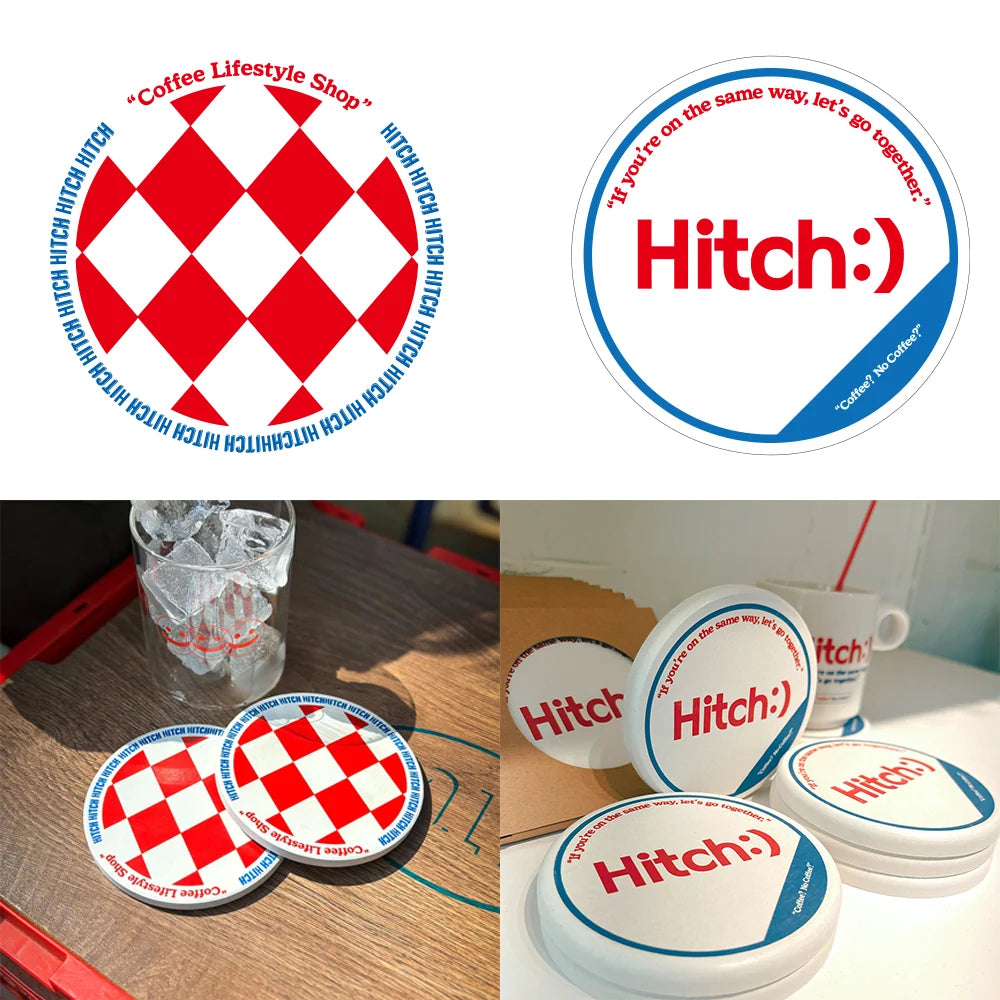
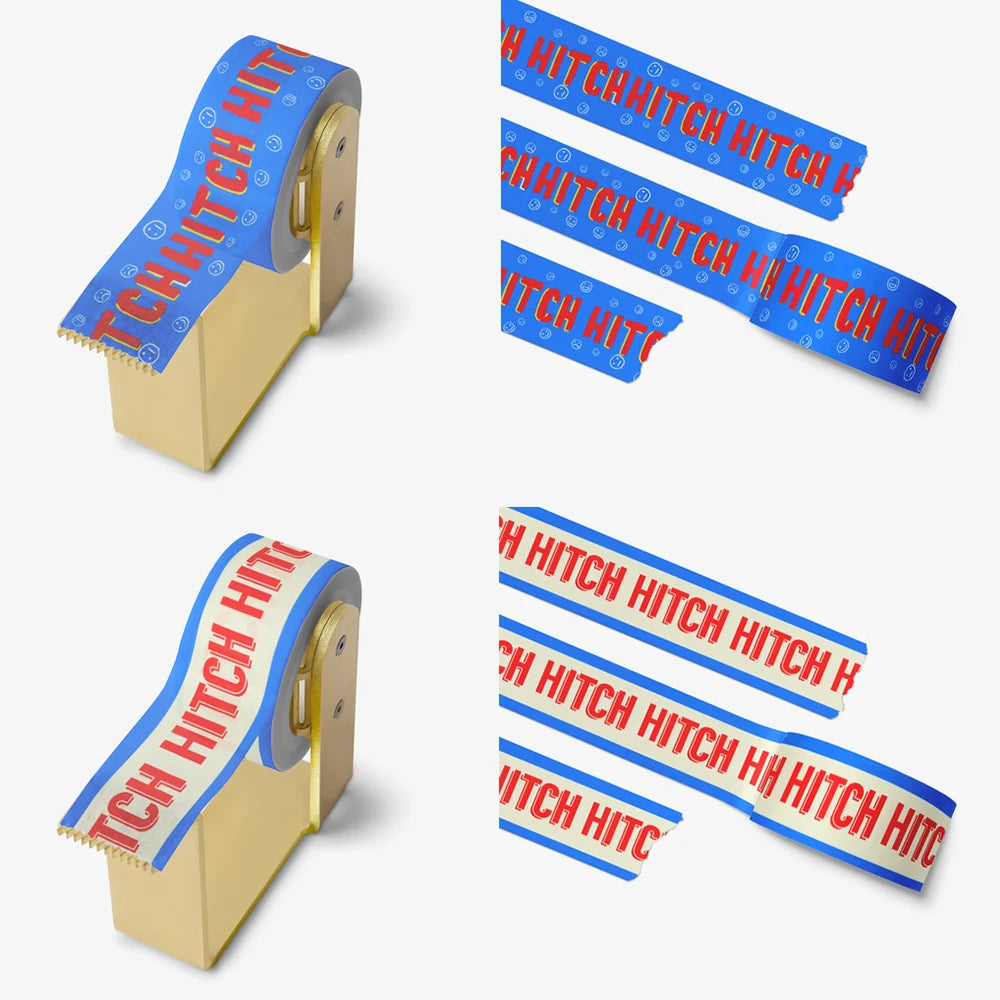
You made a wide range of merchandise. Was it a strategy for extending the brand?
At first, the owner felt that showing things beyond coffee would make the branding more substantial. We began with cups and clothing, which customers noticed most in the café, and gradually added more. Coffee was the starting point; we widened the points of contact a little at a time.
Which items were most popular?
Mostly things used inside the café, such as coasters and blankets. Stickers were one of the few items used outside it. Because the café was in an office district, stationery such as masking tape also did well.
There was one item with no real connection to coffee: a lighter. Customers who smoked would casually pick one up at the till and say, ‘This too, please.’ In fact, the lighter was our best seller. [Laughs.] The principle was clear: apart from the more expensive clothing, these should be things someone could comfortably add when buying a drink in the neighbourhood.
Alongside design and barista work, you also handled promotion and marketing.
Apart from sales outreach, marketing and design moved almost as one. I had never wanted to join a large company. I wanted a more dynamic way of working, and a sense of belonging mattered to me. A big organisation can feel fixed, with everyone doing an assigned task. In a small business, you can see the results of your ideas and work right in front of you. That suited me.
I didn’t start by deciding to take charge of marketing. While designing, I kept thinking about how something could sell better or improve revenue. That naturally led me to suggest, ‘Shall we try this? What about that?’ We discussed the ideas and put them into practice together, and my role grew from there.
Sales grew substantially. What do you think made the biggest difference?
The brand became clearly visible to people. The two most decisive things were attending major coffee fairs such as Café Show, and social media.
Was there anything you tried that didn’t work out?
YouTube. I appeared in the videos rather than planning them. The roaster and the owner were both very interested in video, so we gave it a try.
We eventually stopped because there was nobody dedicated to it. The people doing the day-to-day work also had to make the videos, and there simply wasn’t enough time to prepare. When sales grow, the amount of core work grows too. After a full day of roasting, it wasn’t realistic for the roaster to edit long videos. The project naturally came to a stop.
Finding a shared understanding with the owner
Where do you begin with a new client?
First, I listen to the brand’s own story. I take time to understand its existing character and history, then ask the client for references that show where they would like the brand to go.
I think everyone is a designer with their own criteria. Each person finds different things beautiful or good. What looks right to me as a designer may not look right to the owner. Getting our thinking in sync is therefore the most important part. I first gather the things the owner responds to, then work them into the brand’s existing character without making them feel out of place.
Sometimes clients aren’t sure what they want. They might simply ask for something ‘clean and premium’.
Exactly. That’s why I also offer references myself. I show a specific image and ask, ‘How does this feel?’ Often that is when someone can say clearly, ‘Actually, it isn’t this direction I want; it’s more like this.’
Something similar happened with a Japanese client a few months ago. I followed their references closely, but it turned out they wanted my personal style, rather than the style of those references. They were looking for a collaboration with Chae Suin as a designer, not simply an outsourced design service. Once I understood that, I brought my own character fully into the merchandise, and we finished happily. To avoid these subtle misunderstandings, exchanging references often and having plenty of conversations works better than communicating through formal reports alone.
You don’t stop at proposals. You supervise printing, choose paper and even carry a tape measure to check dimensions. Why take on all those details yourself?
Perhaps because I mainly work with small brands, the actual finished object matters most to me. Small brands have limited budgets. A well-known branding agency may have separate designers and assistants to handle those practical details, but that can be beyond a small brand’s budget. I believe the designer working with a small brand should take responsibility for that practical work too.
The finished object has to be right for me to feel comfortable charging for the work. That is why I communicate as much as possible throughout the process and make repeated revisions when necessary. Counting every revision and charging extra each time doesn’t suit me. What matters most is thinking it through together until we have a real object everyone is happy with.
What a designer does in the age of AI
AI can produce a convincing design in seconds. Does that make you anxious as a designer?
If all I did was make a proposal on a screen and hand it over, the progress of AI would make me anxious. As the technology became more capable, that work could soon be replaced.
But AI cannot take over the things I have just described: asking detailed questions about what an owner truly wants, measuring a folding carton myself, recommending one structure over another, placing a print order, or feeling paper with my fingertips to find the right stock. AI may make recommendations from data, but reaching precisely the result a brand needs also takes conversations and experience gained in the field. So I’m not anxious. I would rather use AI intelligently to make the result better.
How do you use AI in your everyday work?
For repetitive, time-consuming work and supporting tasks: putting a design onto a packaging mock-up or creating simple design assets. I used to spend time paying for resources or searching for free ones. Now I can leave that groundwork to AI and spend my time on the essential planning and on refining the details.
I build the overall structure and character of the design myself, then use AI for a little further processing. If you hand the whole thing over to AI at the start, it becomes difficult to make precise changes later. The technology may improve, but for now a person working directly on the details can still be much more sensitive.
AI cannot replace the work I do in the field. That is why, if anything, I’m not anxious.Suin

Working with Suin
Packaging design is an optional service within Tinge of Soul’s OEM/ODM partnerships. We first discuss the deliverables, printing specifications and launch schedule, then confirm the scope and quotation.
- Brand Concept
Set the direction
Clarify product positioning, the target customer and the core message to establish clear design criteria.
- Visual Direction
Shape the first impression
Bring colour, typography and graphic elements together into a consistent first impression.
- Package Application
Design for the selling format
Develop the design for real retail formats and dimensions, from individual cartons to retail and gift sets.
- Production Handoff
Prepare for production
Organise print-ready files and specifications, including paper selection, print-supervision criteria and dielines.